Key Points
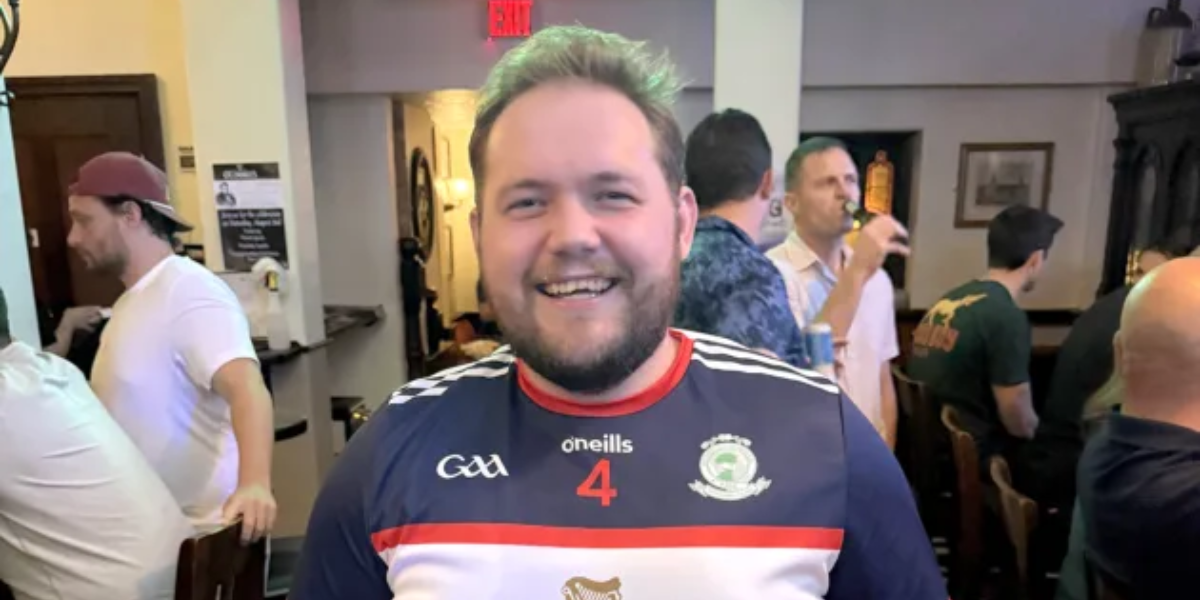
- Aaron Mills, a native of Altoona, Pennsylvania, uses amateur Gaelic football to connect with his Irish ancestry and roots.
- Mills has played over 20 matches with the Michael Collins Gaelic Football Club, competing at the World Gaelic Athletic Association games in Waterford, Ireland, in July 2025, and winning “The Plate” at the USGAA finals in August 2025.
- Beyond playing as a full-back (wearing number three), Mills serves on his club’s board as the public relations officer and was unanimously awarded the team’s 2025 spirit award.
- Gaelic football is experiencing substantial growth in the United States, operating as an amateur sport driven by community involvement and sportsmanship.
WASHINGTON, D.C. (Ireland Now News) October 24, 2026 – Aaron Mills, a native of Altoona, Pennsylvania, has reconnected with his Irish ancestry by participating in amateur Gaelic football across the United States and abroad. Serving as both a player and board member for his local club, Mills has completed more than 20 regular-season matches, represented his team at international games in Ireland, and earned recognition for his contributions to the sport’s growth. The following report details his journey, the mechanics of the sport, and its cultural significance within the American mid-Atlantic region.
- Key Points
- How Did Aaron Mills Transition From Youth Athletics to Gaelic Football?
- What Is Gaelic Football and How Is the Game Played?
- How Did the Team Perform in Ireland and at the USGAA Finals?
- What Impact Has Aaron Mills Made On and Off the Field?
- Background of Gaelic Football’s Expansion in North America
- Prediction: How This Development Will Affect American Amateur Athletes and Heritage Communities
As reported by the original news sources, Aaron Mills stated that “Being on the club’s board and playing an ancient game that goes back hundreds of years that’s linked to my heritage … this is different.”
Since late winter 2025, Mills has competed in more than 20 matches with his team and participated in the World Gaelic Athletic Association games held in Waterford, Ireland, from July 13 to July 17. Reflecting on the international competition, Mills stated that “That was truly a once-in-a-lifetime experience,” adding that “It was an honor to play where the games were from and where my ancestors were from.”
How Did Aaron Mills Transition From Youth Athletics to Gaelic Football?
Growing up in Altoona, Mills participated in traditional American sports, alternating between baseball and lacrosse during his grade school years. His family moved frequently across western Pennsylvania due to his father’s career in retail. Mills attended McAuliffe Heights Elementary School through the sixth grade before relocating to Erie, where he attended McDowell High School.
During a junior high football game, Mills gained early athletic experience on the gridiron. According to his stepmother, Rhonda Mills, he tackled future Arizona Cardinals running back James Conner. Rhonda Mills stated, “He [Mills] was dragged several yards, but he eventually tackled James Conner.”
In the 11th grade, his family relocated to Boardman, Ohio, where Mills completed his high school education. He subsequently attended the University of South Carolina, earning a bachelor’s degree in political science and government. During his collegiate years, Mills stepped away from organized team athletics to focus on personal fitness, though he continued following professional sports teams including the Pittsburgh Steelers, the Pittsburgh Penguins, and Penn State football. Mills noted, “I was always curious.”
After moving to Alexandria, Virginia, Mills was introduced to the sport by his college roommate, Alex, who connected him with Dan McCormick, the secretary of the Michael Collins Gaelic Football Club. Mills subsequently joined the local men’s recreational group as a player and assumed the role of public relations officer on the club’s board.
Describing his initial experience with the sport, Mills stated, “I showed up and enjoyed it. I had no idea what I was doing at the first practice. It’s a different sport than anything in the States.”
What Is Gaelic Football and How Is the Game Played?
Gaelic football is a traditional Irish sport that combines elements of association football (soccer) and rugby. According to official game descriptions provided by the Gaelic Athletic Association (GAA), the sport is played with a ball slightly smaller than a standard soccer ball. Players are permitted to carry the ball in their hands for up to four steps, after which they must either kick it, hand-pass it, bounce it, or perform a “solo”—an action where the ball is dropped onto the foot and kicked back up into the hands.
Mills plays the “full-back” position, wearing jersey number three. In this role, he is responsible for organizing the defensive line, challenging opposition attackers, and protecting his team’s goal.
As reported by Dan McCormick, secretary of the Michael Collins Gaelic Football Club, McCormick recognized Mills’s Irish-American background from their initial meeting and believed he would suit the sport. McCormick stated, “He’s been on the team since then, and he’s been a huge asset.”
Mills’s team competes under the governing framework of the United States Gaelic Athletic Association (USGAA), the national governing body responsible for Gaelic games across the country, including men’s and women’s Gaelic football, hurling, and camogie.
Discussing the atmosphere surrounding the domestic league, Mills noted, “Which makes the GAA so special. Everyone is in it for the love of the game.”
How Did the Team Perform in Ireland and at the USGAA Finals?
The Gaelic football competitive calendar typically begins in late winter and concludes in mid-summer. Mills commented on his progression through his debut season, stating, “Coming into my first match, I was like, ‘What have I got myself into,’ But I picked up the game and found my groove with it.”
From July 13 to July 17, Mills and his teammates traveled to Waterford, Ireland, to compete in the World Gaelic Athletic Association games, where they faced local Irish teams. Mills observed that in Ireland, players are required to represent the specific counties of their birth. He noted a distinct culture of sportsmanship surrounding the sport, stating, “It’s one of those games that town rivals can still have a drink together after the game. Everyone has a good nature about it.”
Following their international tournament appearance and a 20-game regular season, the Michael Collins Gaelic Football Club participated in the USGAA finals held from August 14 to August 16. The team secured one win and suffered one loss, ultimately winning “The Plate,” the trophy designated for the top-performing team in the competition’s secondary bracket.
What Impact Has Aaron Mills Made On and Off the Field?
In addition to his athletic contributions, Mills earned formal recognition from his peers during the 2025 season. As reported by Dan McCormick, Mills was awarded the club’s 2025 spirit award in recognition of his conduct during matches and his stewardship of the team’s social media presence. McCormick stated, “He won the club spirit award mainly because of his actions on and off the field, and the club unanimously voted for him.”
Rhonda Mills commented on her stepson’s involvement with the club, emphasizing his positive attitude and willingness to assist fellow players. Rhonda Mills stated, “I think that’s an amazing quality you don’t see in a lot of people.” She further noted that her husband expressed pride in their son for actively embracing the Irish heritage passed down from his ancestors.
Following the conclusion of the official USGAA season, the team has continued to organize exhibition matches, including a scrimmage against Penn State University on October 17.
Regarding the regional growth of the sport, McCormick noted that four to five clubs operate within a two-hour radius inside the mid-Atlantic division, which encompasses Washington, D.C., and Baltimore. McCormick stated, “The sport is growing substantially in the U.S. It’s cool to see it continue to grow.”
Looking ahead to upcoming seasons, Mills stated, “At the end of the day, knowing all the guys are friends and we make this happen, it’s different in a way.”
Background of Gaelic Football’s Expansion in North America
Gaelic football originated in Ireland as an ancient athletic pastime before being formally organized in 1884 with the establishment of the Gaelic Athletic Association (GAA). While historically centered on the island of Ireland, Irish emigration during the 19th and 20th centuries established expatriate communities across North America, leading to the creation of local clubs in major immigration hubs such as New York, Boston, Chicago, and Philadelphia.
The modern administration of the sport in North America is overseen by the United States Gaelic Athletic Association (USGAA), which acts as the governing body for all operational regions outside the jurisdiction of New York GAA. The USGAA coordinates regional divisions—including the Mid-Atlantic, North East, Midwest, Western, and South Eastern divisions—and organizes national championship tournaments annually.
Over the past two decades, the demographic makeup of Gaelic sports in the United States has expanded beyond first-generation Irish immigrants. Australian, American, and other non-native players have increasingly joined local clubs, supported by public awareness campaigns, social media engagement, and collegiate exhibition matches. The sport operates entirely under amateur principles worldwide, prohibiting player compensation and relying on volunteer governance, local sponsorship, and participant-funded travel.
Prediction: How This Development Will Affect American Amateur Athletes and Heritage Communities
The continued expansion of Gaelic football and the USGAA framework in non-traditional athletic markets is predicted to impact several key groups within the American amateur sports landscape:
- Increased Participation Among Adult Recreational Athletes: As adult athletes look for team sports beyond standard basketball, soccer, or softball leagues, Gaelic football provides an accessible cross-training alternative. The blend of skills required—combining elements of handling, footwork, and tactical positioning—appeals to former high school and collegiate athletes seeking structured competitive outlets.
- Cultural Preservation for Heritage Communities: For Irish-American communities and individuals seeking cultural connections, organized sporting bodies serve as non-academic hubs for heritage engagement. The opportunity to participate in international tournaments like the World Gaelic Athletic Association games offers second- and third-generation descendants direct interaction with Irish sporting traditions.
- Expansion of Regional Sports Tourism and Collegiate Clubs: The establishment of regional clusters—such as the Mid-Atlantic division spanning Washington, D.C., Baltimore, and Pennsylvania—reduces travel barriers for local teams. This geographical density is predicted to accelerate the creation of university-level club programs (as evidenced by recent exhibition matches involving institutions like Penn State University), strengthening youth recruitment pipelines and expanding municipal sports infrastructure for niche sports.